
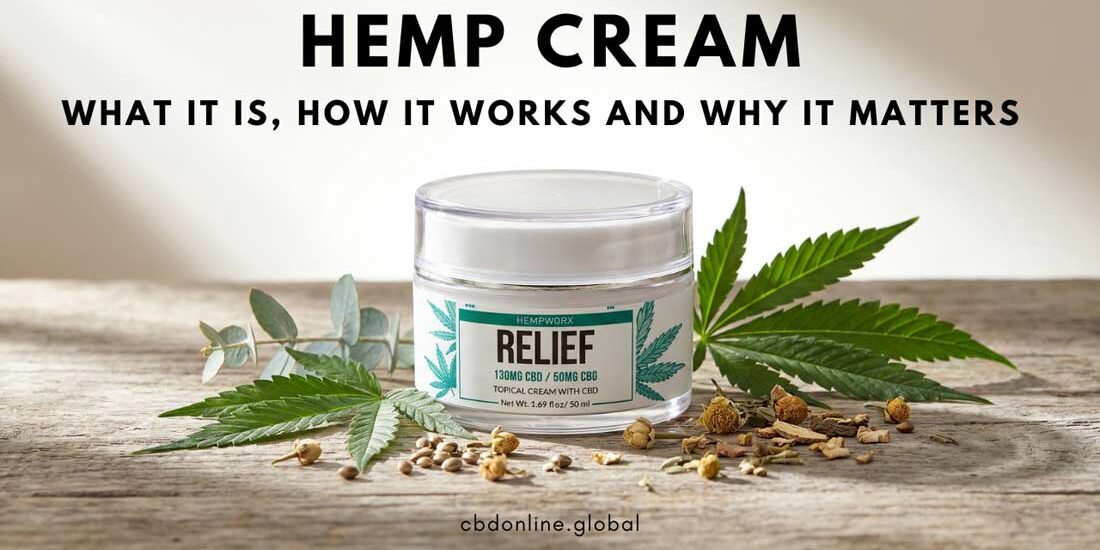
Hemp Cream: What It Is, How It Works, and Why the Formula Matters
I have been selling and using hemp products since 2014, and if there is one category where consumer confusion runs the deepest it is hemp cream. People pick up a jar expecting one thing, get something entirely different, and walk away thinking hemp does not work for them. Most of the time the problem is not hemp. It is the product they chose.
This guide covers what hemp cream actually is, why formulas vary so dramatically, what the science says about how it works on the skin, and what to look for before you spend money on anything.
What Hemp Cream Actually Is, and What Most People Get Wrong
Walk into any wellness store or search online and you will find dozens of products calling themselves hemp cream. Most of them are not what people assume they are buying.
The vast majority of products labelled as hemp cream are built on hemp seed oil. Hemp seed oil comes from the seeds of the hemp plant and contains no cannabidiol and no cannabigerol. It is rich in essential fatty acids, vitamin E, and omega 3 and omega 6 fatty acids, and it genuinely is a high quality moisturizing oil. But it contains no cannabinoids whatsoever. If you buy a hemp cream and the label lists hemp seed oil as the primary ingredient without mentioning CBD or any cannabinoid content, you are buying a moisturizer with excellent skin nourishing properties, not a cannabinoid topical.
The second category is CBD hemp cream. These products use hemp extract rather than or in addition to hemp seed oil, and they contain measurable amounts of cannabidiol. This is a fundamentally different product because CBD interacts with the body at a cellular level through a system that most people have never heard of but that researchers have been studying intensively for decades.
Knowing which type you are buying is the single most important thing you can do before purchasing any hemp topical.
Your Skin Has Its Own Endocannabinoid System
The reason CBD-based hemp creams work differently from hemp seed oil creams comes down to the endocannabinoid system. Most people know the endocannabinoid system exists somewhere in the body but they do not realize that the skin has its own version of it.
Research published in the International Journal of Molecular Sciences has documented that the skin contains CB1 and CB2 receptors, the same cannabinoid receptor types found throughout the central nervous system, as well as additional receptor types including TRPV channels and PPARs. These receptors are found in keratinocytes, the cells that form the outer layers of the skin, as well as in immune cells, sebaceous glands, and hair follicles.
A comprehensive review published in 2025 in Biomolecules described how CBD interacts with this cutaneous endocannabinoid system through multiple molecular pathways, producing what researchers identified as anti-inflammatory, antioxidant, and skin-protective effects. The same review noted that preclinical and clinical evidence supports CBD’s role in managing several skin conditions related to inflammation and barrier disruption.
This is why a cream built on CBD extract behaves so differently at the skin level compared to a cream built on hemp seed oil alone. The hemp seed oil feeds the skin. The CBD interacts with it.
Why the Carrier Oil Makes or Breaks a Hemp Cream
Here is where most hemp cream formulations fall short in a way that never gets discussed. Even when a cream contains good quality CBD extract, the carrier oil determines whether those cannabinoids stay on the surface of the skin or actually reach the deeper layers where they can do meaningful work.
Most hemp creams use coconut oil, shea butter, or jojoba as their base. These are pleasant ingredients and they moisturize well, but they are not penetration enhancers. The cannabinoids in a cream built on these bases tend to stay in the upper layers of the stratum corneum rather than traveling deeper into the dermis and the muscle tissue beneath.
Emu oil is different. Research published in Inflammopharmacology documented that emu oil applied to the skin can function as an effective inhibitor of chronic inflammation, and a separate study published in PubMed examined the penetration enhancement mechanism of emu oil at the molecular level, finding that it actively disrupts the organized lipid structure of the stratum corneum in a way that allows other compounds to travel deeper through the skin layers.
Emu oil has been used in Aboriginal Australian medicine for generations, which is worth noting not as marketing but as historical context. When researchers examined it in formal laboratory settings they found measurable evidence supporting what traditional users had observed for centuries.
The practical implication for hemp cream shoppers is real. A CBD cream in an emu oil base delivers its active ingredients deeper into the skin than the same cream in a coconut oil base. The choice of carrier is not cosmetic. It changes what the product can actually do.
CBG: The Ingredient That Changes the Conversation
Cannabidiol gets all the attention but there is another cannabinoid that has been gaining serious ground in the research literature, and that is cannabigerol, commonly known as CBG.
CBG is sometimes called the mother cannabinoid because it is the precursor from which many other cannabinoids, including CBD and THC, are synthesized in the growing hemp plant. It is present in smaller amounts than CBD in most hemp varieties, which historically made it expensive to produce at scale. That has changed as extraction and production techniques have improved, and researchers have taken notice.
A 2022 study published in Molecules by Perez and colleagues at Signum Biosciences evaluated CBG in human dermal fibroblasts and epidermal keratinocytes exposed to multiple inflammatory inducers including UVA radiation, UVB radiation, and bacterial agents. The results were striking. CBG reduced reactive oxygen species better than vitamin C in those cell types, and in several instances it inhibited pro-inflammatory cytokines including Interleukin-1 beta, Interleukin-6, Interleukin-8, and tumor necrosis factor alpha more potently than CBD. The same study conducted a 20-subject clinical trial with a topical CBG serum and found statistically significant improvement in transepidermal water loss and redness reduction compared to placebo.
A 2024 study published in Biomedicine and Pharmacotherapy went further, investigating how CBG produces its anti-inflammatory effects through specific molecular pathways. The researchers identified the JAK/STAT and NF-kB signaling pathways as key mechanisms through which CBG modulates inflammatory responses in skin tissue.
Most recently, a 2025 paper in the International Journal of Molecular Sciences by Formato and colleagues examined combinations of CBG and CBD on rheumatoid arthritis synovial fibroblasts and found that the combination of the two cannabinoids downregulated cytokine-induced interleukin-6 release more effectively than either compound alone.
This last finding is particularly important because it points to something the hemp industry has been calling the entourage effect for years. When cannabinoids work together, the result is greater than the sum of the parts. A hemp cream that contains both CBD and CBG in a well-designed formula is not the same as one containing CBD alone.
The Difference Between Full Spectrum, Broad Spectrum, and Isolate in a Hemp Cream
When you look at the label of a hemp cream you will often see one of three terms: full spectrum, broad spectrum, or isolate. These matter.
Full spectrum hemp extract contains CBD along with all the other naturally occurring cannabinoids in the plant, including trace amounts of THC below the legal 0.3 percent threshold. The full range of plant compounds works together, and research suggests this produces a more complete effect than any single compound in isolation.
Broad spectrum extract contains CBD and other cannabinoids but goes through additional processing to remove detectable THC entirely. For people who want the benefit of multiple cannabinoids without any THC presence at all, broad spectrum is the right choice.
Isolate is pure CBD with no other cannabinoids. It is the simplest and least expensive option to produce and it lacks the synergistic benefits of the other spectrum types.
If a hemp cream label does not specify which type of extract it uses, that is worth asking about before buying.
What to Look for in a Quality Hemp Cream
After more than a decade in this space I have a fairly clear list of what separates a quality hemp topical from something that will disappoint you.
Third party lab testing is the first thing I look for. Any credible hemp cream manufacturer will have their products tested by an independent laboratory for cannabinoid content, heavy metals, pesticides, and contaminants. Those results should be accessible. If a company does not publish them, move on.
Meaningful cannabinoid concentration matters. Some products contain such small amounts of hemp extract that the CBD content is functionally negligible. Look for a product that specifies the total milligram content clearly.
Ingredient transparency is non-negotiable. The label should tell you exactly what is in the product. If you cannot find a full ingredient list, that is a reason for concern.
The carrier base deserves attention for the reasons outlined earlier. Look for products that list the carrier oil clearly and consider whether it is one known to support deeper delivery.
USDA Organic certification or US Hemp Authority certification are both positive signals. They require actual verification rather than just a claim on the label.
Finally, a meaningful guarantee. A company confident in its product stands behind it. A 30-day money back guarantee including used product is the standard worth expecting.
How to Apply Hemp Cream for Best Results
Hemp cream is straightforward to use but there are a few things that genuinely affect how well it works.
Apply to clean dry skin. Warm the cream slightly between your palms before applying since this helps with absorption. Use a generous amount and take the time to actually massage it in rather than just rubbing it across the surface. The mechanical action of massage improves circulation in the applied area and supports delivery into the tissue.
Use it consistently. One application tells you very little. People who get the most out of hemp topicals use them regularly as part of their routine rather than reaching for them only when discomfort is already significant.
Why I Use Hempworx Relief Cream After 12 Years in This Industry
I have tried a lot of hemp creams. Occupational hazard of selling wellness products for over a decade is that you end up evaluating everything on the market at one point or another.
The Hempworx Relief Cream is the one I keep coming back to. It contains broad spectrum CBD and CBG together, which for the reasons the research supports is more meaningful than CBD alone. It uses emu oil as its carrier base, which for the reasons outlined above changes how deeply the active ingredients can travel. And it contains no detectable THC.
Beyond the formula, it is USDA Organic certified, triple third-party tested, and backed by Immunotec (makers of Immunocal), a company with 45 years of wellness research and 79 global patents. That scientific infrastructure behind the manufacturing and quality control matters to me, and it matters to the customers who have been reordering this product for years.
The 30 day money back guarantee is genuine. An empty jar qualifies. That is a company standing behind what it makes.
Those who prefer their cannabinoids delivered through a daily oil rather than a topical may want to start with the Hempworx 750, which pairs well with the cream for a complete routine.
If you want to explore the full Hempworx product range or read a detailed breakdown of how the brand compares to alternatives in the CBD space, the Hempworx review covers everything in depth.
To order directly or ask questions before you buy, call 1-833-633-4367, Monday through Friday, 9 AM to 6 PM PST.
These statements have not been evaluated by the Food and Drug Administration. This product is not intended to diagnose, treat, cure, or prevent any disease.
Authorized Hempworx and Immunotec Affiliate since 2014 | ID #3123749
References:
CBG clinical study (Perez et al., 2022) https://www.ncbi.nlm.nih.gov/pmc/articles/PMC8778347/
CBG anti-inflammatory via JAK/STAT pathways (Jukič et al., 2024) Biomedicine and Pharmacotherapy — search: “Anti-Inflammatory Activity of Cannabigerol via JAK/STAT and NF-κB Signaling Pathways in Atopic Dermatitis”
CBG and CBD combination on rheumatoid arthritis (Formato et al., 2025) International Journal of Molecular Sciences — search: “CBG, CBD, and Their Combinations Downregulate Cytokine-Induced IL-6 Release from Rheumatoid Arthritis Synovial Fibroblasts”
CBD topical comprehensive review (2025) https://pmc.ncbi.nlm.nih.gov/articles/PMC12467061/
Emu oil anti-inflammatory/penetration research https://pubmed.ncbi.nlm.nih.gov/17638122/
Emu oil penetration mechanism (FTIR study, 2017) https://pubmed.ncbi.nlm.nih.gov/28527394/
4 Comments