


Table of Contents
- Understanding CBD for Dogs: What Pet Owners Need to Know
- Calculate Your Dog’s CBD Serving by Body Weight
- Is CBD Effective for Dog Anxiety: What the Evidence Shows
- Best Practices for Giving CBD to Pets
- How Long Does CBD Stay in a Dog’s System
- Monitoring Your Dog’s Response and Adjusting Servings
- Safety, Side Effects, and When to Consult Your Veterinarian
- Bioavailability and How Delivery Method Affects Absorption
- Frequently Asked Questions
Last Updated: September 3, 2026
Understanding CBD for Dogs: What Pet Owners Need to Know
CBD, short for cannabidiol, is a naturally occurring compound found in hemp plants that interacts with a dog’s endocannabinoid system to support balance and wellness. At CBD Online, we’ve spent over a decade helping pet owners understand how to serve CBD for dogs safely and effectively. The key difference between serving CBD and other treatments lies in its gentle approach to supporting your dog’s natural systems without the side effects associated with conventional medications.
Pet owners often ask whether CBD is right for their dogs. The answer depends on understanding your dog’s individual needs, body weight, and health status. Before starting any CBD regimen, consult with your veterinarian to rule out underlying conditions and ensure CBD won’t interact with existing medications.
Calculate Your Dog’s CBD Serving by Body Weight
Determining the correct serving size is the foundation of safe CBD use for dogs. Body weight is the primary factor that guides serving calculations, though individual metabolism and the specific condition being addressed also play roles.
The Milligrams Per Kilogram Formula
The standard approach to calculating how to serve CBD for dogs involves using milligrams per kilogram of body weight. Many veterinarians and CBD specialists recommend starting with a conservative range of 0.25 to 0.5 milligrams per kilogram, then adjusting based on your dog’s response over several weeks (aaha.org).
To calculate your dog’s starting serving: multiply your dog’s weight in kilograms by 0.25 to 0.5. For example, a 20-kilogram dog would start with 5 to 10 milligrams of CBD. This formula provides a baseline that accounts for individual variation while remaining within a safe therapeutic window.
Starting with a Conservative Serving
Beginning with the lower end of the recommended range protects your dog while allowing you to observe how their body responds. Many pet owners make the mistake of jumping to higher servings too quickly, missing the subtle improvements that occur at lower levels. A conservative starting approach means you can gradually increase if needed, rather than overshooting and then reducing.
Record your dog’s behavior, energy level, and any target concerns (like anxiety or mobility) before starting CBD. This baseline helps you recognize meaningful changes as you adjust the serving over the coming weeks.
Is CBD Effective for Dog Anxiety: What the Evidence Shows
The question of whether CBD is effective for dog anxiety reflects what many pet owners wonder before trying it. While comprehensive clinical studies on dogs remain limited compared to human research, many pet owners report observing behavioral changes after introducing CBD into their dogs’ routines.
The endocannabinoid system in dogs functions similarly to that in humans, suggesting that CBD’s interaction with cannabinoid receptors may support relaxation and calm. Some veterinary practitioners note that dogs showing signs of anxiety, pacing, excessive barking, or avoidance behaviors sometimes display a more settled demeanor after consistent CBD use.
Results vary significantly between individual dogs. Factors like the dog’s age, overall health, the underlying cause of anxiety, and the quality and potency of the CBD product all influence outcomes. Patience and consistent observation over 4 to 6 weeks provide a more accurate picture than expecting immediate changes.
Best Practices for Giving CBD to Pets
How you administer CBD matters as much as the serving size itself. The method you choose affects how quickly your dog’s body absorbs the cannabidiol and how effectively it reaches the endocannabinoid system.
Choosing the Right Delivery Method
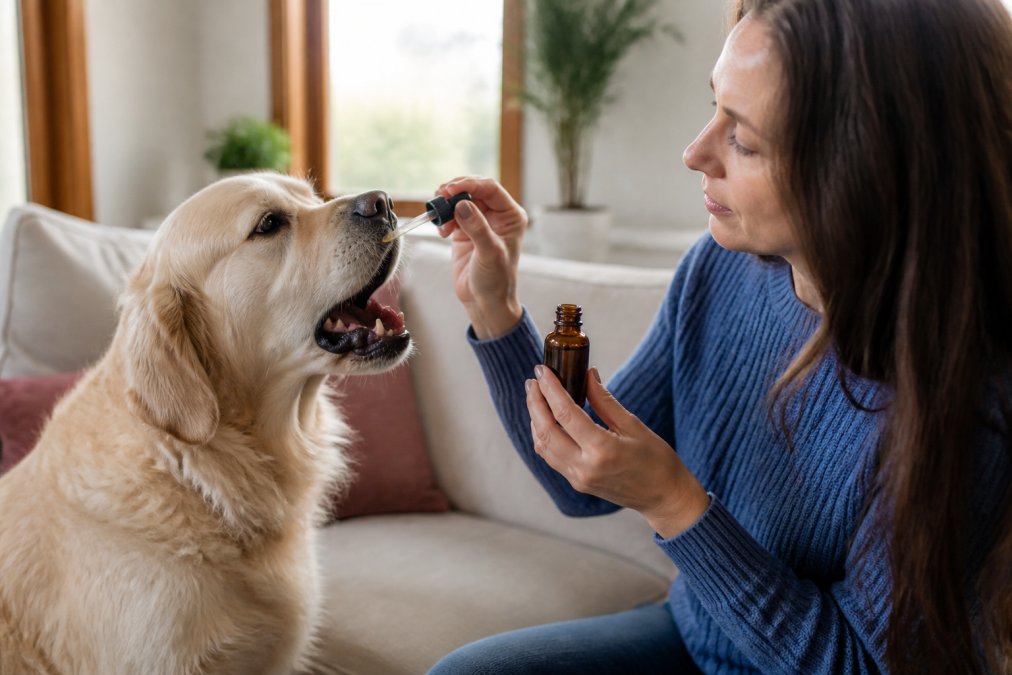
CBD for dogs comes in several delivery forms, each with different absorption characteristics. Tinctures (liquid CBD oils) placed under the tongue or mixed into food offer relatively rapid absorption, typically taking effect within 30 to 60 minutes. Treats infused with CBD provide convenience but may take longer to absorb since they pass through the digestive system.
Topical CBD products like balms or creams target localized areas and work best for joint or muscle discomfort rather than systemic anxiety. When selecting a delivery method, consider your dog’s temperament, whether they’ll accept the taste, and what condition you’re addressing. If you’re uncertain which product format or strength is right for your dog’s needs, Need Help Choosing the Right CBD Product? our team can provide personalized guidance.
Frequency and Timing of Administration
Most pet owners find success giving CBD twice daily, morning and evening, which maintains more consistent levels in the dog’s system. Some dogs respond well to a single daily serving, while others benefit from three smaller servings spread throughout the day.
Consistency matters more than perfect timing. Establishing a routine, giving CBD with meals, for example, makes it easier to maintain regular administration and helps you track whether your dog’s response improves over time.
How Long Does CBD Stay in a Dog’s System
Understanding how long CBD remains active in your dog’s body helps you time servings appropriately and recognize when adjustments might be needed. In dogs, CBD typically remains detectable in the system for 18 to 24 hours, though the most noticeable effects often occur within the first 4 to 8 hours after administration (peer-reviewed research).
This timeframe means that twice-daily servings maintain a more consistent level of cannabidiol in your dog’s system compared to single daily servings. If you’re experimenting with serving frequency, allow at least 3 to 5 days at each frequency level before making changes, since it takes time for steady-state levels to establish.
Monitoring Your Dog’s Response and Adjusting Servings
Careful observation and systematic titration are essential for determining whether your current serving is working or needs adjustment. Pet owners who track their dog’s behavior methodically and follow a structured adjustment protocol make better decisions than those who rely on general impressions or make random changes.
Signs Your Dog Is Responding Well
Positive responses to CBD often appear gradually rather than dramatically. A dog that previously paced nervously might settle more quickly. One that seemed stiff or reluctant to jump might move with slightly more ease. Energy levels may normalize, neither excessive hyperactivity nor unusual lethargy.
These subtle shifts accumulate over weeks. Documenting specific observations, “walked 2 miles without limping today,” “didn’t bark during thunderstorm,” “ate full meal without hesitation”, provides clearer evidence than vague impressions of improvement.
Create a simple tracking sheet or use a notes app to record:
- Baseline behavior (before starting CBD): energy level, anxiety triggers, mobility limitations, appetite
- Weekly observations: specific incidents or changes you notice
- Serving date and amount: when you gave CBD and the exact milligram amount
- Time of day: morning, evening, or both
- Any changes to other medications or routines: diet changes, exercise level, stress events
After 4 to 6 weeks, review your notes. Look for patterns. Did anxiety decrease? Did mobility improve? Did appetite normalize? Concrete observations guide your next decision.
Titration Protocol: A Structured Approach for Chronic Conditions
Titration means gradually adjusting the serving to find the optimal level for your dog’s needs. Rather than random increases, follow a systematic protocol:
Weeks 1-4: Baseline Phase
- Start at the conservative end of the calculated range (0.25 mg/kg of body weight)
- Administer twice daily at consistent times (e.g., 8 AM and 6 PM)
- Observe and document your dog’s response
- Do not adjust during this phase; allow steady-state levels to establish
Week 5: First Assessment
- Review your tracking notes
- If you see meaningful improvement (reduced anxiety, better mobility, improved appetite), continue at this serving for another 2-3 weeks to confirm the effect is stable
- If you see no change or minimal change, proceed to the adjustment phase
Weeks 6-7: First Adjustment (if needed)
- Increase the serving by 25 to 50 percent (e.g., if starting at 5 mg twice daily, increase to 6-7.5 mg twice daily)
- Continue twice-daily administration
- Observe and document for 3-5 weeks before making another change
Week 10: Second Assessment
- Review notes again
- If improvement is now evident, hold at this serving and reassess in 4 weeks
- If still no meaningful change, consider a second increase (another 25-50 percent)
- If your dog shows signs of overdose (lethargy, reduced appetite, gastrointestinal upset), reduce the serving by 25 percent and hold for 2 weeks
Ongoing Maintenance
- Once you identify an effective serving, maintain it consistently for at least 8-12 weeks to confirm stability
- Some dogs reach an effective serving and plateau there; others continue showing incremental improvements as the serving increases, up to a point
- The goal is finding the minimum serving that produces the desired effect, not necessarily the highest possible serving
- Reassess every 3-6 months, especially if your dog’s condition, age, weight, or medications change
Recognizing a Plateau and When to Stop Adjusting
Not every dog responds to CBD, and not every dog needs continuous increases. If after two or three titration steps (spanning 12+ weeks) you see no meaningful improvement, CBD may not be the right approach for your dog’s situation. Discuss alternative strategies with your veterinarian.
Conversely, if your dog shows steady improvement and then plateaus at a given serving, that is often the optimal level. Continuing to increase beyond that point rarely produces additional benefit and may introduce unnecessary side effects.
Seasonal or Situational Adjustments
Some dogs benefit from temporary serving increases during high-stress periods (fireworks season, travel, major household changes) or seasonal anxiety. If you adjust temporarily, return to the baseline serving once the stressor passes. Document these adjustments so you can recognize patterns and plan ahead for predictable stress events.
Safety, Side Effects, and When to Consult Your Veterinarian
CBD is generally well-tolerated by dogs, but understanding potential side effects, toxicity signs, and medication interactions is essential for protecting your pet’s health and ensuring safe concurrent use with existing treatments.
Potential Adverse Effects and Toxicity Signs
At appropriate servings, CBD rarely causes problems. However, excessive amounts may lead to lethargy, reduced appetite, or gastrointestinal upset. These effects typically resolve once the serving is reduced. True toxicity from CBD alone is uncommon in dogs, though it can occur at extremely high levels.
Signs that warrant immediate veterinary attention include severe lethargy that doesn’t improve after reducing the serving, persistent vomiting, or loss of appetite lasting more than a day. Ataxia (loss of coordination or stumbling) at high servings has been reported in some cases and resolves when the serving is lowered.
Drug-Drug Interactions: A Critical Safety Consideration
CBD can interact with certain medications by affecting how your dog’s liver metabolizes them through the cytochrome P450 enzyme system (the FDA). This is not a reason to avoid CBD, but rather a reason to inform your veterinarian before introducing it, especially if your dog takes any of the following medication classes:
Anticonvulsants (seizure medications): Drugs like phenobarbital and levetiracetam are metabolized by the liver in ways that CBD may influence. Dogs on seizure medications require veterinary oversight when starting CBD, as blood levels of the anticonvulsant may shift, potentially affecting seizure control.
NSAIDs and pain medications: While CBD and NSAIDs (nonsteroidal anti-inflammatory drugs) are sometimes used together, both can affect liver function. Your veterinarian may recommend monitoring or adjusting the frequency of liver function tests if your dog takes chronic pain medications alongside CBD.
Immunosuppressants: Dogs with autoimmune conditions or those recovering from transplants may take immunosuppressive medications. CBD’s interaction with the immune system and liver metabolism means these combinations require professional oversight.
Cardiac medications: If your dog takes heart medications such as digoxin or certain beta-blockers, discuss CBD use with your veterinarian, as liver metabolism changes could affect drug levels.
Corticosteroids: Long-term steroid use already affects liver function. Adding CBD requires baseline awareness of your dog’s liver health through bloodwork.
When to Contact Your Veterinarian
Contact your veterinarian before starting CBD if your dog:
- Takes any prescription medication, especially those listed above
- Has a history of liver disease or kidney dysfunction
- Is pregnant, nursing, or a young puppy under 12 weeks old
- Has a known seizure disorder (even if well-controlled)
- Shows signs of illness or is scheduled for surgery
After starting CBD, contact your veterinarian if you observe:
- Changes in appetite or water intake that persist beyond 48 hours
- Vomiting or diarrhea that doesn’t resolve within 24 hours of reducing the serving
- Unusual lethargy, stumbling, or loss of coordination
- Changes in behavior that seem unrelated to the condition you’re treating
- Any sign that your dog’s existing condition has worsened
Baseline Testing and Monitoring
If your dog is on medications that interact with liver metabolism, ask your veterinarian whether baseline bloodwork (liver enzymes and kidney function) would be helpful before starting CBD. This creates a reference point. For dogs on long-term CBD and medications, periodic rechecks (typically annually or as your veterinarian recommends) provide reassurance that liver and kidney function remain stable.
Your veterinarian can review your dog’s specific medication list, health history, and bloodwork to advise whether CBD is appropriate, whether adjustments to other medications are needed, or whether alternative approaches might be safer for your dog’s situation.
Bioavailability and How Delivery Method Affects Absorption
Bioavailability refers to the percentage of CBD that actually reaches your dog’s bloodstream and becomes available to interact with the endocannabinoid system. Different delivery methods have dramatically different bioavailability rates.
Sublingual administration (placing CBD oil under the tongue) bypasses some digestive processing and achieves higher bioavailability than oral products that pass through the stomach and intestines. Treats and capsules offer convenience but lower bioavailability, meaning a larger serving may be needed to achieve the same effect as a smaller sublingual serving.
This difference explains why two products with identical milligram amounts might produce different results. A high-quality tincture from a reputable source, third-party tested for potency and purity, ensures you know exactly what serving your dog is receiving and can predict absorption more reliably. Shop Hempworx Products for USDA Organic hemp options backed by rigorous testing standards.
Serving CBD to your dog requires understanding their body weight, choosing an appropriate delivery method, and monitoring their response over time. The process demands patience; meaningful changes often take weeks to become apparent. Working with your veterinarian throughout ensures your dog’s safety and helps you identify whether CBD genuinely supports their wellness goals or whether alternative approaches might be more effective. CBD Online’s curated selection of USDA Organic hemp products, backed by a decade of daily use and a 30-day money-back guarantee, provides peace of mind that you’re giving your dog a quality serving of CBD.
Frequently Asked Questions
How much CBD should I give my dog based on weight?
Most veterinary guidance suggests starting with 0.25 to 0.5 milligrams per kilogram of body weight, twice daily. A 20-pound dog (roughly 9 kg) would start with approximately 2.25 to 4.5 milligrams per serving. Always begin at the lower end and increase gradually over 1-2 weeks while monitoring your dog’s response. Full-spectrum hemp extract often requires smaller servings than isolate due to higher bioavailability.
Is CBD effective for dog anxiety, and what does the research show?
Some pet owners report their dogs show reduced anxiety behaviors after receiving CBD, though clinical studies in dogs remain limited. The endocannabinoid system plays a role in regulating stress responses, which is why cannabidiol may support relaxation. Results vary by individual dog, delivery method, and product potency. A certificate of analysis from your product ensures accurate cannabinoid content. Consult your veterinarian before starting any regimen, especially if your dog takes other medications.
How long does CBD stay in a dog’s system?
CBD’s pharmacokinetics in dogs show a half-life of approximately 4-6 hours, meaning half the serving is metabolized within that window. Full clearance typically occurs within 24 hours. This timeline supports twice-daily serving schedules for consistent support. Bioavailability varies by delivery method: sublingual tinctures work faster (30-60 minutes) than treats or capsules (1-2 hours). Factors like your dog’s metabolism, body weight, and food intake can affect how quickly CBD is processed.
What signs should I watch for when adjusting my dog’s CBD serving?
Positive signs include improved calm behavior, increased mobility, and better sleep patterns. Watch for adverse effects such as lethargy, ataxia (loss of coordination), or gastrointestinal upset. Most dogs tolerate CBD well, but individual sensitivity varies. If your dog shows signs of toxicity—extreme drowsiness, vomiting, or tremors—reduce the serving immediately and contact your veterinarian. Titration should happen gradually over weeks, not days, to establish your dog’s therapeutic window safely.
